
WTLS: Hail, and thank you for offering this chance to interview you. It is so very much appreciated. Your latest album Rhîw has most definitely been a highlight for me. Are you pleased with the general reception?
Abghül: Thanks. I have been pleasantly suprised by the the response to the record. I suffer from imposter syndrome as an artist and was expecting a sort of negative response. However, those who have taken the time to listen to it have compared it to bieng somewhere between Black Cilice and Paysage D’Hiver. I think this means that I have come pretty close to achieving what I wanted to do sonically when I started writing and recording this album. It is a strange one though, it was released a week after my mother passed away, and because of this it will remain a very bittersweet record personally.
WTLS: If I am correct Rhîw is an elven word in the writings of Tolkien for winter and I think (but please correct me as it’s hardly an area of knowledge of mine) the track titles for the album are about the coming of winter? As I noted in the review this seemed very much the journey through a cold and dark landscape. One in the grip of a harsh season but with all the turbulence and delicate frozen stillness it entails. Was this close? Is there a particular tale you were thinking of with this enveloping music or a simple need to bring the season itself to musical life?
Abghül: I am glad that is what you felt while listening. I have strived for a while to create a record that takes you on a journey. I am as influenced by Pink Floyd and Tangerine Dream as much as by bands like Darkthrone or Mayhem, and I personally like to really envelope myself within an album. It may sound a little pretentious, but I tend to listen to Black Metal and its adjacent genres whilst in isolation, by candlelight and burning incense – this album was written within these settings too.
Rhîw is the Sindarin – the language spoken by most elves within Tolkiens writings- for winter. Winter is a dark, cold season both physically and metaphorically, and within those long dark months we tend to find myself living within isolation and suffering a certain level of despair. I experienced a lot of loss this particular winter, and this record tends to reflect that. The last part of the album is very much about winter of life, the storyteller succumbs to the cold amd learns to accept death.
WTLS: Perhaps a little personal introduction is needed at this point. How would you describe yourself as a musician?
Abghül:I would describe myself as pretty shit.
WTLS: Since 2023 you have been incredibly busy, prolific even. You have several projects which are ongoing and Ghül are now on their third full length. A great achievement. Your previous band, Vándr split up in 2023. Was this the impetus you needed to finally focus on what was bubbling away inside? Do you see Ghül as your main focus now? What purpose do the other projects serve for you?
Abghül: I very much started Ghül as a passion project on my own. Vándr, my previous project were very much more a traditional band in approach. At the time I found a one-person project completely liberating so I decided to focus on that. I have plenty of other “side-projects.” These all start in different ways, but am the type who hyperfocuses once I find the inspiration for something, which may come from plenty of different sources; the state of humanity within the world, our surroundings, a book or a poem and of course other music. However, I would say most inspiration comes from a feeling. I also have a few completely anonymous releases out there as well. In fact – I am working on one right now.
WTLS: Your recording history seems to have only begun in 2020 from my feeble research. What were you doing before that artistically? What changed and made you decide that you had to express yourself through music that you would release? What instruments do you consider yourself proficient in? Are you self taught, tutored or a mix?
Abghül: I have been quietly kicking around the scene for a while, but it was basically around then I started writing for myself. I had some major changes in my life which allowed me the time to do this, as the years preceding this had been pretty tough without going into too much detail.
I would hope I am competent at least in the instruments I play. Guitar, Bass, Synths and Keys and the little bit of drums I play, but I guess it is for other people to decide that. I had lessons many years ago, and the parts I retained from this more than anything is the music theory side of things, which is important whether people choose to admit it or not. You will only get so far without it.
WTLS: Do you prefer working alone? What advantages and disadvantages does it bring? For the tech heads (alas I’m not one but others will be interested I know) what is you setup for recording?
Abghül: I very much prefer working alone, my creative process is a very personal one, which I will not really divulge to anybody. I have also yet to find somebody that will match myself in terms of ambition and my vision. When I say ambition I don’t mean selling loads of records or getting as many instagram likes, I don’t really give a fuck about stuff like that, and the somewhat vacuous validation that can be gained from it. I don’t do this to be an influencer, and until I find people to work with who understand that by ambition I mean on a creative and artistic scale, I guess I will work alone.
I am not really a tech-head either, and my setup is a fairly simple, an audio interface, some guitar stuff, keyboard, drums and that is about it really. I’m more interested in the creative process, my surroundings and where my emotions take me than gear, what type of guitar you play or whether you use tube-amps or modelling, if you can’t tap into yourself and create, these are all irrelevant.

WTLS: Ghül’s first releases up until the debut album were very much raw black metal. Gradually with Fuin Eriol Na-Ghul the atmospherics heightened until you released Stormcrow last year which was an dark, wonderful ambient album. I’m sure some were surprised at this seeming detour. What inspired doing this shift? Would you call it dark ambient, dungeon synth or…?
Abghül: I’m not sure what I would call it, apart from that it was part of a musical journey. Again, as I referred to earlier, it was driven mostly by a feeling, and that it felt right to do at the time. I have always wanted to explore expression through different ways, and try not to get too bogged down or pigeonholed by things.
WTLS: Following Stormcrow things have from my point of view at least resettled themselves in a place where the raging black metal and the deeply atmospheric ambient have found a wonderful way to co-exist which is how we reached the wonderful blend that is Rhîw. Tell us something about how you realised this evolution was the direction that Ghül had to travel in? Is this driven by story telling?
Abghül: It just seemed like a natural progression. You are correct that this was indeed driven by storytelling. The whole album does have a narrative, a journey through an inhospitable winter before succumbing to and accepting death to find peace, even crying out for it. Each section represents part of this journey as it all ties together, some parts provide respite, some despair and pain before drawing to a conclusion.

WTLS: As we have reached the place of stories, Ghül are very much a Tolkien themed project it seems. Now this may be an impossible task (or an impossibly long answer!) but…I have read Tolkien, of course, but I am not an obsessive or even avid reader of his work – more of a REH, Lieber and Moorcock fan if I’m honest.
Whilst I completely appreciate how his work and world captivates a great many people, I have often found the incredible grip he has on the world of black metal a little puzzling if I’m honest To me as a casual fan his is a world of bright shining elves, etherial women, funny brave and stubborn little hobbits and a faceless army of dark undifferentiated evil. Yes his metaphors of the terrible war he knew and the almost dislocation from the gentle world he returned to run deep and are beautifully crafted and of course his facility with language is unparalleled in fantasy writing but I have never found his world particularly grim in upfront aspect outside of orcs and such and I found little real insight into them on reading the books.
So how does this mesh with black metal, usually a wild, dark, harsh soundscape and often looking from the point of view of darkness and evil for you? What is it about the world of Middle Earth that compels yourself (and so many others) to create such amazing and dark music?
Abghül: This is a genuinely interesting question and discussion. It can seem quite puzzling the influence Tolkien has over the genre, especially considering how much of his works are overtly steeped in his own catholicism. We see sacrifice and resurrection, very black and white views of good and evil and literal fallen deities as antagonists. This is only touching on these themes and we could discuss this for hours and hours, perhaps we should sometime. It is, however, quite well documented and there is a lot of source reading on Tolkien’s faith and how it affected his works.
However, his writings are widely loved by those that do listen to Black Metal. Perhaps as a traditionalist, his views and his writings appeal to those who reject modernity, and although they are influenced by his Catholicism, they were also very much influenced by his studies of medieval, Norse and northern European legend, and he was in fact THE Beowulf scholar. You can draw direct comparisons for example from parts of Lord of the Rings to the sagas of Harald Sigurdson, and he often referred to ideas of northern courage and stoicism.
His legendarium is so absolutely vast that the depth of inspiration that you can take from it on a number of different levels can be astounding. I would say that there are certainly parts of it, especially The Silmarillion, that are full of despair, grimness and tragedy, much more so than Lord of the Rings.
I think it is also worth taking into consideration that generally Black Metal in the uk seems to mostly made up of white, middle-class men and because of the lack of class-struggle or consciousness, along with the more secular nature of English society compared to other places within Europe, the scene has had to draw on other influences for its own identity.
Perhaps the short answer though is that Black Metal musicians and fans tend to be nerds.
WTLS: As we have discussed literary inspirations, what about musical? What inspires your black metal, your more ambient aspects? There are odd, little touches of a sound similar to earlier Dead Can Dance in some of the ambient, maybe and some of the wilder sounds of some black metal artists. Would you consider your musical loves broad or more focussed? Has this changed since your own music became more prevalent? What is your current listening list like?
Abghül: I would generally say they are quite broad, I tend to listen to anything I find interesting. I am neither a gatekeeper or an elitist, and I think that the most important aspect of music for me is the emotional side. This doesn’t always necessarily mean pain or sadness either, sometimes it can be music that conveys joy.
Black Metal wise I have been spinning Paysage D’Hiver, Pa Vesh En, Hauntologist and many others.
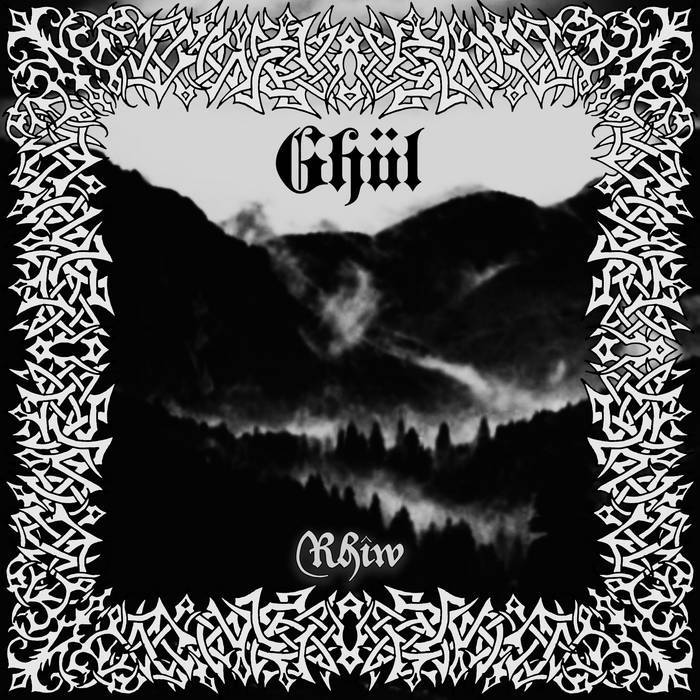
WTLS: I’ve noted that the covers to your releases, with two exceptions, are all black and white. Is this simply a black metal aesthetic or is there a more fundamental reason. Is artwork something you are interested in?
Abghül: There is a fairly simple answer to this to be honest, my ex-girlfriend painted that artwork. The others she didn’t.
WTLS: You played a handful of live dates last year I saw (but sadly couldn’t attend). Did you enjoy that or are you more a person who prefers the studio? Who did you choose as your live band? Do you intend to do more gigs in the future? What would be the perfect way to present and album like Rhîw in a live capacity; would you see it
Abghül: I generally prefer the studio and creative side of things. In all honesty, I need to go back to the drawing board when it comes to the live side of things. Presenting an album like Rhîw in a live capacity would be a challenge.
WTLS: Thank you again fro the opportunity to talk to you, it really is appreciated. Any last words?
Abghül: Thanks for the fantastic review, the interesting discussion and keep an eye and an ear out. More is coming.
Questions posed by Gizmo
 Walking The Liminal Space